Export Offshore Wind Cable Market Size & Growth Forecast 2027–2036, By Segments (Voltage Rating, Conductor Material), Regional Demand Trends (North America, Asia Pacific, Europe), Key Country Insights (U.S., Japan, South Korea, Germany, France, Italy), and Competitive Landscape
Jump to content
Market Size and Growth Outlook
Export Offshore Wind Cable Market size was valued at USD 4.55 Billion in 2026 and is anticipated to grow at 32.84% CAGR from 2027 to 2036, reaching USD 77.86 Billion by 2036. The industry revenue for 2027 is estimated at USD 5.87 Billion.
Get more details on this report
Request Free Sample ReportExport Offshore Wind Cable Market Intelligence Snapshot
Regional Market Dynamics
- Europe led in 2026 through its mature offshore wind ecosystem, renewable energy commitments, expanding offshore capacity, and investments in grid integration and clean energy infrastructure.
- Asia Pacific is accelerating through expanding offshore wind development, renewable infrastructure investment, rising electricity demand, and improving marine infrastructure and cable installation capabilities.
Segment Momentum
- Copper held the largest conductor material share in 2026 due to its superior electrical conductivity, mechanical strength, and long-term reliability, making it the preferred choice for high-capacity offshore power transmission.
- Aluminum is projected to be the fastest-growing conductor material as developers increasingly adopt lightweight, cost-efficient cable solutions supported by improvements in cable design and material performance for large offshore wind projects.
Market Expansion Drivers
- Offshore wind expansion accelerating high-voltage export cable deployment
- Government renewable mandates driving offshore transmission infrastructure investments
- Cross-border renewable energy interconnection projects strengthening offshore grid networks
Leading Market Participants
- Top players in the export offshore wind cable market include Prysmian Group (Italy), Nexans S.A. (France), NKT A/S (Denmark), LS Cable & System Ltd. (South Korea), Sumitomo Electric Industries, Ltd. (Japan), Furukawa Electric Co., Ltd. (Japan), Hengtong Group Co., Ltd. (China), JDR Cable Systems Ltd. (United Kingdom), ZTT Group (China)
Global Market Forecast Snapshot
Market Outlook
- 2026 Market Size: USD 4.55 Billion
- 2027 Estimated Market Size: USD 5.87 Billion
- Projected Market Size: USD 77.86 Billion by 2036
- Growth Forecast: 32.84% CAGR (2027-2036)
Regional and Segment Outlook
- Leading Regional Market: Europe
- High-Growth Regional Hub: Asia Pacific
- Core Revenue Segment: 132 kV & Above (Voltage Rating) | Copper (Conductor Material)
- Emerging Opportunity Segment: 132 kV & Above (Voltage Rating) | Aluminum (Conductor Material)
Market Growth Drivers and Industry Trends
Offshore wind expansion accelerating high-voltage export cable deployment
The rapid development of offshore wind projects is creating substantial demand for high-capacity transmission infrastructure, which will drive the export offshore wind cable market growth as new generation assets are connected to onshore electricity networks. Offshore wind farms require reliable export cables capable of transmitting large volumes of electricity over long subsea distances while minimizing transmission losses and ensuring dependable grid connectivity. High-voltage export cables form a critical link between offshore substations and mainland transmission systems, supporting efficient delivery of renewable electricity from increasingly distant offshore generation sites.
Government renewable mandates driving offshore transmission infrastructure investments
National renewable energy policies and decarbonization initiatives are encouraging large-scale investments in offshore transmission systems, strengthening the export offshore wind cable market across established and emerging offshore wind regions. Governments promoting clean energy deployment are supporting the construction of offshore generation capacity alongside the associated electrical infrastructure needed to integrate renewable power into national grids. These investments increase demand for export cables that provide secure and efficient electricity transmission while enabling utilities and developers to meet renewable energy targets through reliable offshore grid connections.
Cross-border renewable energy interconnection projects strengthening offshore grid networks
Increasing collaboration between neighboring countries on renewable energy integration will propel the export offshore wind cable market growth by expanding offshore transmission networks beyond national boundaries. Cross-border interconnection projects enable participating regions to exchange renewable electricity, improve grid flexibility, and optimize utilization of offshore wind resources across interconnected power systems. Export offshore cables play a central role in these developments by supporting long-distance subsea electricity transmission while enhancing energy security, balancing variable renewable generation, and strengthening regional offshore grid infrastructure.
| Growth Driver | Impact on CAGR | Regulatory Influence | Geographic Relevance | Adoption Rate | Impact Timeline |
|---|---|---|---|---|---|
| Offshore wind expansion accelerating high-voltage export cable deployment | 2% | High | Europe, Asia Pacific | High | Near Term |
| Government renewable mandates driving offshore transmission infrastructure investments | 1.5% | High | Europe | High | Near Term |
| Cross-border renewable energy interconnection projects strengthening offshore grid networks | 1% | High | Europe, Middle East | Emerging | Long Term |
Unlock insights tailored to your business with our bespoke market research solutions.
Click to get your customized report now.
Regional Demand Dynamics
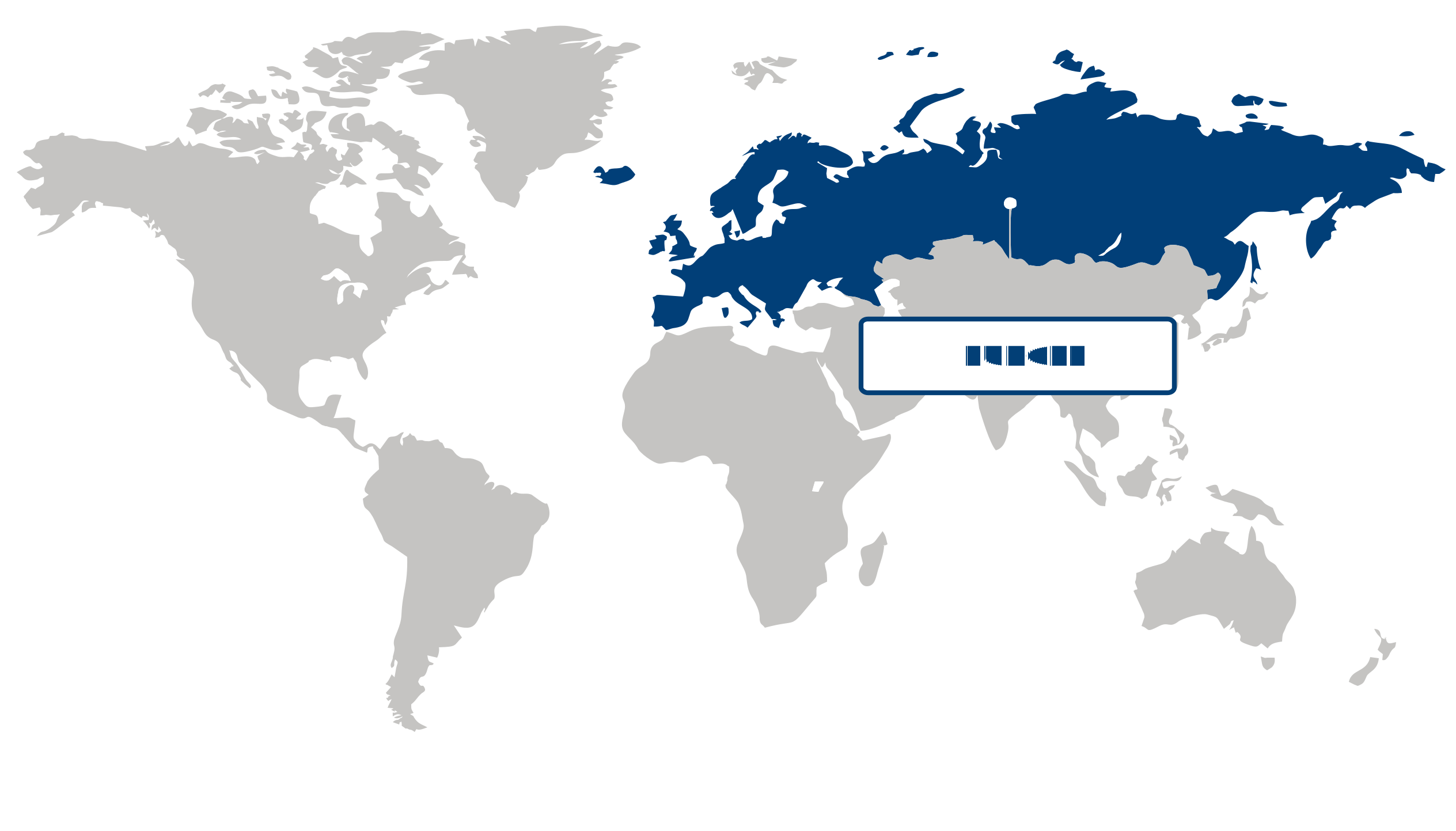
Europe (Largest Region)
Europe dominated the export offshore wind cable market in 2026, supported by its mature offshore wind ecosystem, strong renewable energy commitments, and continued expansion of offshore electricity infrastructure. The region's increasing deployment of offshore wind capacity is generating demand for export cables that transmit electricity from offshore installations to onshore grids. Grid integration initiatives, investments in clean energy infrastructure, and the need for reliable long-distance power transmission are further strengthening the regional market outlook.
Asia Pacific (Fastest-Growing Region)
Asia Pacific is the fastest-growing region for the export offshore wind cable market, driven by expanding offshore wind development and rising investment in renewable power infrastructure. Growing electricity demand and efforts to diversify energy portfolios are encouraging countries across the region to accelerate offshore wind deployment. As offshore projects become an increasingly important component of regional power systems, demand for dependable export cable technologies is expected to gain momentum, supported by improvements in marine infrastructure and cable installation capabilities.
| Parameter | North America | Asia Pacific | Europe | Latin America | MEA |
|---|---|---|---|---|---|
| Innovation HubiScaleNascentDeveloping Advanced | |||||
| Cost-Sensitive RegioniScaleLowMedium High | |||||
| Regulatory EnvironmentiScaleRestrictiveNeutral Supportive | |||||
| Demand DriversiScaleWeakModerate Strong | |||||
| Development StageiScaleEmergingDeveloping Developed | |||||
| Adoption RateiScaleLowMedium High | |||||
| New Entrants / StartupsiScaleSparseModerate Dense | |||||
| Macro IndicatorsiScaleWeakStable Strong |
Key Country Insights
United States 🇺🇸
Grid Connection ExpansionThe U.S. is strengthening export offshore wind cable demand through expanding offshore wind leasing activity and large-scale grid interconnection projects. Suppliers are prioritizing high-capacity cable systems, domestic manufacturing partnerships, and resilient installation capabilities to support utility-scale developments.
Germany 🇩🇪
Transmission Integration FocusGermany continues to prioritize export offshore wind cables that support North Sea wind integration and cross-border transmission planning. Market activity emphasizes advanced cable reliability, efficient installation methods, and compatibility with evolving offshore grid infrastructure.
Japan 🇯🇵
Deepwater Deployment StrategyJapan is advancing export offshore wind cable adoption alongside floating and deepwater offshore wind projects. The market increasingly values durable cable designs, seabed installation expertise, and solutions capable of operating under challenging marine conditions.
South Korea 🇰🇷
Industrial Supply AlignmentSouth Korea is reinforcing its export offshore wind cable market through coordinated shipbuilding, cable manufacturing, and offshore engineering capabilities. Developers are focusing on integrated project delivery and dependable high-voltage transmission infrastructure for new offshore installations.
France 🇫🇷
Offshore Grid ModernizationFrance is expanding offshore renewable projects that require export offshore wind cables aligned with evolving coastal transmission infrastructure. Procurement increasingly favors proven cable technologies that simplify installation while supporting long-term operational reliability in marine environments.
Italy 🇮🇹
Mediterranean Project SupportItaly is increasing investment in offshore renewable infrastructure, creating demand for export offshore wind cables suited to Mediterranean project conditions. Market participants are emphasizing flexible engineering, efficient cable routing, and dependable grid integration for future offshore capacity.
Export Offshore Wind Cable Market Share (%), by Voltage Rating, 2026
Go beyond the chart, access full insights & data tables
Request Free Sample ReportVoltage Rating Segment Analysis: 132 kV & Above (Largest & Fastest-Growing Segment)
The export offshore wind cable market was led by the 132 kv & above voltage rating segment, which accounted for 88.4% of the market in 2026 while also emerging as the fastest-growing segment. High-voltage export cables are essential for transmitting large volumes of electricity from offshore wind farms to onshore grids with greater efficiency and lower transmission losses. Their increasing adoption is supported by the development of larger offshore wind projects, expanding transmission distances, and growing investment in high-capacity renewable energy infrastructure. As offshore wind installations continue to increase in scale, demand for higher-voltage cable systems is expected to remain strong.
Conductor Material Segment Analysis: Copper (Largest Segment) vs Aluminum (Fastest-Growing Segment)
The copper conductor material segment held the largest share in the export offshore wind cable market in 2026, owing to its superior electrical conductivity, mechanical strength, and long-term reliability under demanding offshore operating conditions. Copper conductors are widely preferred for high-capacity transmission applications where efficient power transfer and operational durability are critical. Increasing deployment of utility-scale offshore wind farms further reinforced the segment’s dominant position in 2026.
The aluminum conductor material segment is expected to witness the fastest growth as developers increasingly seek lightweight and cost-efficient cable solutions for large offshore wind installations. Improvements in cable design and material performance are enhancing the suitability of aluminum conductors for high-voltage transmission while helping reduce overall project costs. Continued expansion of offshore renewable energy infrastructure is expected to support the segment’s rapid adoption.
| Segment | Sub-Segment | Largest Segment | Fastest Growing |
|---|---|---|---|
| Voltage Rating | 132 kV & Less, 132 kV & Above | 132 kV & Above | 132 kV & Above |
| Conductor Material | Aluminum, Copper | Copper | Aluminum |
Competitive Landscape and Market Positioning
Prominent players in the export offshore wind cable market:
- Prysmian Group (Italy)
- Nexans S.A. (France)
- NKT A/S (Denmark)
- LS Cable & System Ltd. (South Korea)
- Sumitomo Electric Industries Ltd. (Japan)
- FurUKawa Electric Co., Ltd. (Japan)
- Hengtong Group Co., Ltd. (China)
- JDR Cable Systems Ltd. (United Kingdom)
- ZTT Group (China)
Rivalry is increasingly shaped by the ability to deliver complete cable solutions that combine high transmission reliability with efficient installation for large offshore developments. Manufacturers are strengthening engineering capabilities around advanced insulation systems, enhanced mechanical durability, and cable designs suited to deeper waters and more demanding seabed conditions, where technical performance increasingly outweighs conventional price competition. Competitive positioning also depends on production planning, specialized testing capacity, and close alignment with complex project timelines, encouraging suppliers to expand manufacturing flexibility and strengthen project execution capabilities for utility-scale offshore deployments.
| Company | Market Share | Company Revenue | Revenue CAGR (%) | Product Portfolio | Geographic Presence | Innovation / R&D Focus | Strategic Developments |
|---|---|---|---|---|---|---|---|
| Prysmian Group (Italy) | |||||||
| Nexans S.A. (France) | |||||||
| NKT A/S (Denmark) | |||||||
| LS Cable & System Ltd. (South Korea) | |||||||
| Sumitomo Electric Industries Ltd. (Japan) | |||||||
| Furukawa Electric Co. Ltd. (Japan) | |||||||
| Hengtong Group Co. Ltd. (China) | |||||||
| JDR Cable Systems Ltd. (United Kingdom) | |||||||
| ZTT Group (China) |
Industry Development / News
| Company Name | Date | Key Development |
|---|---|---|
| Jan De Nul Group | Jan-24 | Jan De Nul Group signed a contract with Ørsted in January 2024 to provide installation and protection services for two DC export cables spanning 350 km for the Hornsea 3 offshore wind farm located off the UK coast, supporting regional renewable power supply infrastructure. |
| Nexans | Nov-23 | Nexans completed the installation of its 138 kV export cables spanning 110 km at the South Fork Offshore Wind Farm for Eversource and Ørsted in November 2023, facilitating the transmission of 132 MW of power to Long Island, New York. |
Customize Your Report
Explore examples of how this report can be tailored to different research needs, including custom segments, additional topics or chapters, and related reports. Click a section of the wheel or its numbered marker to explore the available options.
Export Offshore Wind Cable Market — Custom Segments
| Segment | Sub-Segment |
|---|---|
| Offshore Wind Project Type | Fixed-Bottom, Floating |
| Cable Installation Method | Burial, Rock Placement, Surface-Laying |
| Procurement Model | Direct Procurement, EPC/Turnkey Procurement, Framework/Long-Term Contract |
Export Offshore Wind Cable Market — Custom TOC
| Custom Chapter | Chapter Details |
|---|---|
| Export Corridor Opportunity Mapping |
|
| Offshore Cable Supply Chain Resilience |
|
| Cable Installation Capacity Assessment |
|
Need a different cut of the data?
Request Custom ResearchFrequently Asked Questions
How large is the export offshore wind cable market?
How is the export offshore wind cable industry expected to grow over the next 10 years?
How is offshore wind expansion driving demand for export offshore wind cables?
Why are government renewable policies and cross-border grid projects important for the export offshore wind cable market?
Why does copper lead the conductor material segment in the export offshore wind cable market?
Which conductor material is expected to grow the fastest in the export offshore wind cable market?
How did Europe maintain leadership in the export offshore wind cable market in 2026?
Why is Asia Pacific the fastest-growing region for export offshore wind cables?
Who holds a significant market share in the export offshore wind cable landscape?
Our Clients
"The information presented in the report was genuinely insightful. The data was clear and easy to understand, which made it much easier to interpret the findings."
Amara Raja Group
"The responsiveness and professionalism exhibited by the team were exemplary. They were readily available to address queries, provide clarifications, and offer additional insights."
ONGC
"The reports offered a comprehensive analysis of various segments within the market. The detailed insights into market trends, and regulatory landscapes were excellent."
TotalEnergies
Our Research Team & Methodology
Every Fundamental Business Insights report is built by a dedicated vertical research team, validated through a structured primary-and-secondary methodology, and reviewed for accuracy before it reaches you.
Delivery
Published
Available
Support
- Market Size & Forecast
- Market Segmentation
- Regional Analysis
- Growth Drivers & Challenges
- Market Dynamics
- Competitive Landscape
- Company Profiles
- Competitive Benchmarking
- Mergers & Acquisitions
- Market Share Analysis or Key Company Strategies
- Value Chain Analysis
- Porter's Five Forces
- PESTLE Analysis
- Pricing Trends
- Supply-Demand Analysis
- Technology Landscape
- Regulatory Landscape
- Investment & Funding Landscape
- Emerging Opportunities
- Future Market Outlook