Flavors and Fragrances Market Size & Growth Forecast 2027–2036, By Segments (Application, Product), Regional Demand Trends (North America, Asia Pacific, Europe), Key Country Insights (U.S., Japan, South Korea, Germany, France, Italy), and Competitive Landscape
Jump to content
Market Size and Growth Outlook
Flavors and Fragrances Market size stood at USD 35.7 billion in 2026 and is predicted to grow at a 6.75% CAGR from 2027 to 2036, surpassing USD 68.6 billion by 2036. The industry revenue for 2027 is estimated at USD 37.73 billion.
Get more details on this report
Request Free Sample ReportFlavors and Fragrances Market Intelligence Snapshot
Regional Market Dynamics
- Europe accounted for 33.18% of the market in 2026, supported by established ingredient manufacturers, advanced formulation capabilities, and steady demand for premium, customized flavor and fragrance solutions.
- Asia Pacific is expected to grow at a 6.22% CAGR as rising consumption of packaged foods, beverages, beauty, and home care products drives manufacturing expansion and ingredient sourcing demand.
Segment Momentum
- Fragrance held a 75.07% market share in 2026 due to strong demand across personal care, cosmetics, home care, and fine fragrances, where scent plays a major role in product identity and consumer preference.
- Natural products are the fastest-growing segment as manufacturers increasingly prioritize cleaner formulations and naturally derived ingredients to align with label-conscious purchasing behavior and evolving consumer expectations.
Market Expansion Drivers
- Rising demand for clean-label and natural ingredients driving reformulation of flavor and fragrance products.
- Expanding food processing and premium personal care consumption boosting sensory ingredient demand.
- Advances in biotechnology and AI-driven formulation enabling cost-efficient flavor innovation.
Leading Market Participants
- Top players in the flavors and fragrances market include Givaudan SA (Switzerland), DSM-Firmenich AG (Switzerland), Symrise AG (Germany), International Flavors & Fragrances Inc. (United States), Takasago International Corporation (Japan), Sensient Technologies Corporation (United States), MANE SA (France), BASF SE (Germany), Robertet Group (France), T. Hasegawa Co., Ltd. (Japan).
Global Market Forecast Snapshot
Market Outlook
- 2026 Market Size: USD 35.7 billion
- 2027 Estimated Market Size: USD 37.73 billion.
- Projected Market Size: USD 68.6 billion by 2036
- Growth Forecast: 6.75% CAGR (2027-2036)
Regional and Segment Outlook
- Leading Regional Market: Europe
- High-Growth Regional Hub: Asia Pacific
- Core Revenue Segment: Fragrance (Application) | Natural (Product)
- Emerging Opportunity Segment: Flavors (Application) | Natural (Product)
Market Growth Drivers and Industry Trends
Rising demand for clean-label and natural ingredients driving reformulation of flavor and fragrance products
Growing consumer preference for recognizable, naturally derived, and minimally processed ingredients is encouraging manufacturers to reconsider the composition of products used across food, beverages, personal care, and household applications. The flavors and fragrances market is being supported by this shift as manufacturers reformulate sensory ingredients to align with clean-label expectations while maintaining desirable taste and aroma characteristics. Demand for natural extracts, botanical sources, and ingredients perceived as more transparent is encouraging innovation in sourcing and formulation, while producers are also adapting flavor and fragrance profiles to satisfy consumers who increasingly examine ingredient lists and seek products associated with natural positioning.
Expanding food processing and premium personal care consumption boosting sensory ingredient demand
Expansion in processed food and beverage production is increasing the need for flavor systems that improve taste, consistency, and product differentiation across a broad range of applications. At the same time, rising consumption of premium personal care products is supporting demand for distinctive fragrances that enhance product appeal and create differentiated sensory experiences. These trends will boost the flavors and fragrances market as manufacturers seek specialized sensory ingredients for new formulations, product upgrades, and premium offerings. Increasing product variety across packaged foods, beverages, cosmetics, toiletries, and other consumer categories is also creating opportunities for customized flavor and fragrance solutions suited to specific formulations and consumer preferences.
Advances in biotechnology and AI-driven formulation enabling cost-efficient flavor innovation
Technological progress in biotechnology is expanding the range of methods available for producing and developing flavor ingredients, while artificial intelligence is improving formulation and product-development processes. The flavors and fragrances market is gaining from these advances as manufacturers use data-driven tools to evaluate ingredient combinations, identify desirable sensory profiles, and reduce inefficiencies during formulation development. Biotechnology can support the development of novel ingredients through controlled biological processes and alternative production pathways, while AI-assisted analysis can help optimize formulations based on sensory characteristics, ingredient interactions, and production requirements, enabling more targeted development of differentiated flavor solutions.
| Growth Driver | Impact on CAGR | Regulatory Influence | Geographic Relevance | Adoption Rate | Impact Timeline |
|---|---|---|---|---|---|
| Rising demand for clean-label and natural ingredients driving reformulation of flavor and fragrance products | 2.30% | Moderate | Europe, Asia Pacific | High | Near Term |
| Expanding food processing and premium personal care consumption boosting sensory ingredient demand | 2.00% | Moderate | North America, Asia Pacific | High | Near Term |
| Advances in biotechnology and AI-driven formulation enabling cost-efficient flavor innovation | 1.70% | Moderate | Europe, North America | Medium | Mid Term |
Unlock insights tailored to your business with our bespoke market research solutions.
Click to get your customized report now.
Regional Demand Dynamics
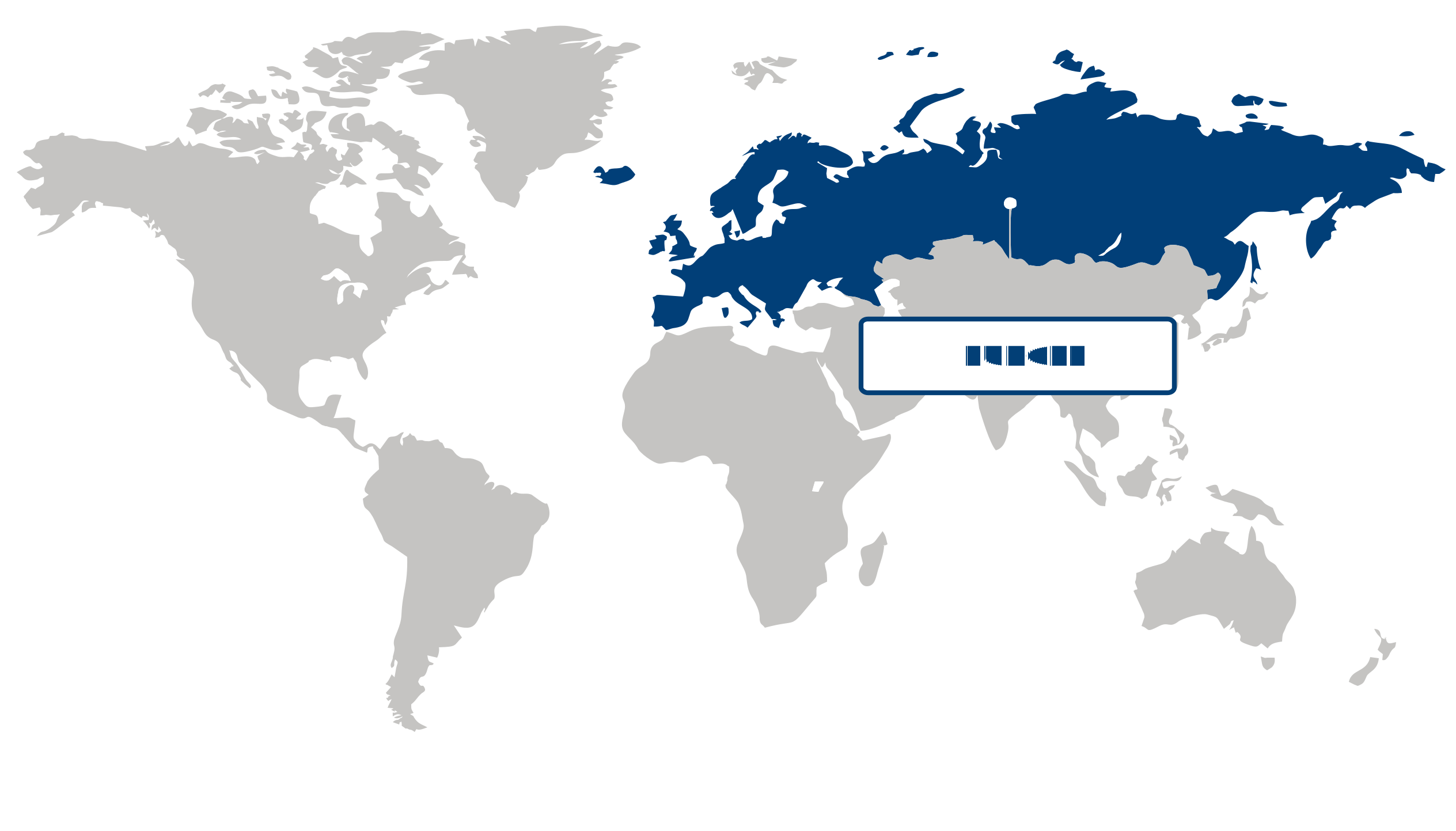
Europe (Largest Region)
In the flavors and fragrances market, Europe held the largest share at 33.18% in 2026, reflecting its well-established food, beverage, cosmetics, and personal care industries and strong consumer preference for premium and differentiated products. The region benefits from sophisticated manufacturing capabilities, extensive expertise in formulation, and a mature ecosystem supporting natural, clean-label, and specialty ingredients. Stringent regulatory requirements concerning ingredient safety and product composition have also encouraged innovation in compliant and high-quality flavor and fragrance formulations. Demand for premium personal care products, innovative food offerings, and environmentally conscious ingredients continues to reinforce Europe’s market position.
Asia Pacific (Fastest-Growing Region)
Asia Pacific represents the fastest-growing regional market, supported by expanding food and beverage production, rising disposable incomes, and evolving consumer preferences across both emerging and established economies. Urbanization and the growth of modern retail channels are broadening demand for packaged foods, beverages, cosmetics, and personal care products that rely on distinctive flavor and fragrance profiles. Manufacturers are also responding to growing interest in natural ingredients, localized tastes, and premium product experiences, creating opportunities for formulation innovation. Increasing industrialization and the expansion of consumer-oriented manufacturing capacity further strengthen the region’s long-term growth prospects.
| Parameter | North America | Asia Pacific | Europe | Latin America | MEA |
|---|---|---|---|---|---|
| Innovation HubiScaleNascentDeveloping Advanced | |||||
| Cost-Sensitive RegioniScaleLowMedium High | |||||
| Regulatory EnvironmentiScaleRestrictiveNeutral Supportive | |||||
| Demand DriversiScaleWeakModerate Strong | |||||
| Development StageiScaleEmergingDeveloping Developed | |||||
| Adoption RateiScaleLowMedium High | |||||
| New Entrants / StartupsiScaleSparseModerate Dense | |||||
| Macro IndicatorsiScaleWeakStable Strong |
Key Country Insights
Germany 🇩🇪
Sustainable Formulation ExpertiseGermany emphasizes precision formulation and sustainable ingredient sourcing for flavors and fragrances used in food, cosmetics, and household products. German manufacturers increasingly adopt renewable feedstocks and advanced extraction technologies to support regulatory compliance and product consistency.
France 🇫🇷
Premium Fragrance HeritageFrance combines established fragrance expertise with innovation in sustainable formulations and luxury product development. French companies continue expanding bio-based ingredients and environmentally responsible production methods while preserving premium fragrance craftsmanship.
Italy 🇮🇹
Specialty Ingredient CraftsmanshipItaly emphasizes premium flavors and fragrances for food, beverages, fine fragrances, and personal care products. Italian producers increasingly combine traditional ingredient expertise with modern formulation technologies to deliver differentiated sensory experiences for global customers.
Japan 🇯🇵
Refined Sensory DevelopmentJapan focuses on sophisticated flavor and fragrance development tailored to premium food, beverage, and beauty applications. Japanese companies continue refining subtle aroma profiles and functional ingredients that align with consumer expectations for quality and product authenticity.
South Korea 🇰🇷
Beauty Ingredient IntegrationSouth Korea supports flavors and fragrances through strong demand from cosmetics, personal care, and innovative food products. South Korean manufacturers increasingly develop distinctive scent profiles and natural flavor solutions that strengthen product differentiation across domestic and export markets.
United States 🇺🇸
Consumer Innovation FocusThe U.S. flavors and fragrances market prioritizes product differentiation through clean-label formulations, premium sensory experiences, and customized ingredient solutions. Companies in the U.S. continue investing in biotechnology and natural raw materials to address evolving consumer preferences across food, beverages, and personal care.
Flavors and Fragrances Market Share (%), by Application, 2026
Go beyond the chart, access full insights & data tables
Request Free Sample ReportApplication Segment Analysis: Fragrance (Largest Segment) vs Flavors (Fastest-Growing Segment)
The fragrance segment led the flavors and fragrances market with a 75.07% share in 2026, reflecting the broad incorporation of fragrance ingredients across personal care, household products, cosmetics, and other consumer applications. Fragrance formulations contribute to product differentiation and consumer appeal, making them an important component of product development across multiple industries. Growing consumer interest in sensory experiences, premium personal care products, and differentiated household products continues to support strong demand for fragrance ingredients.
Flavors are experiencing the fastest growth as food and beverage manufacturers increasingly focus on improving taste profiles, product differentiation, and consumer acceptance. Flavor systems are essential for developing new formulations and adapting products to evolving preferences, including demand for distinctive and more natural-tasting offerings. Continued innovation in food and beverage products, together with expanding opportunities across functional and convenience-oriented categories, is supporting increasing use of flavor ingredients.
Product Segment Analysis: Natural (Largest & Fastest-Growing Segment)
The natural segment held the largest share of the flavors and fragrances market at 54.18% in 2026 and is also the fastest-growing segment. Its strong position is being reinforced by rising consumer preference for ingredients perceived as natural, clean-label, and aligned with sustainability-oriented product choices. Manufacturers across food, beverages, personal care, and household products are increasingly incorporating natural flavor and fragrance ingredients to respond to changing expectations around ingredient transparency and product formulation. This broad cross-industry shift toward naturally derived inputs is strengthening demand and supporting continued expansion of the natural segment.
| Segment | Sub-Segment | Largest Segment | Fastest Growing |
|---|---|---|---|
| Application | Flavors, Fragrance | Fragrance | Flavors |
| Product | Natural, Aroma Chemical | Natural | Natural |
Competitive Landscape and Market Positioning
Major players in the flavors and fragrances market:
1. Givaudan SA (Switzerland)
2. DSM-Firmenich AG (Switzerland)
3. Symrise AG (Germany)
4. International Flavors & Fragrances Inc. (United States)
5. Takasago International Corporation (Japan)
6. Sensient Technologies Corporation (United States)
7. MANE SA (France)
8. BASF SE (Germany)
9. Robertet Group (France)
10. T. Hasegawa Co. Ltd. (Japan)
Consumer preference shifts toward natural and customized sensory experiences are shaping formulation innovation. The flavors and fragrances market is witnessing continuous experimentation with botanical extracts and bio-based compounds. Advanced scent engineering techniques are enabling more stable and long-lasting profiles. Expanding application areas across food, personal care, and wellness products are reinforcing product diversification strategies.
| Company | Market Share | Company Revenue | Revenue CAGR (%) | Product Portfolio | Geographic Presence | Innovation / R&D Focus | Strategic Developments |
|---|---|---|---|---|---|---|---|
| Givaudan SA (Switzerland) | |||||||
| DSM-Firmenich AG (Switzerland) | |||||||
| Symrise AG (Germany) | |||||||
| International Flavors & Fragrances Inc. (United States) | |||||||
| Takasago International Corporation (Japan) | |||||||
| Sensient Technologies Corporation (United States) | |||||||
| MANE SA (France) | |||||||
| BASF SE (Germany) | |||||||
| Robertet Group (France) | |||||||
| T. Hasegawa Co. Ltd. (Japan). |
Industry Development / News
| Company Name | Date | Key Development |
|---|---|---|
| Turpaz Industries | May-25 | Turpaz Industries completed the acquisition of Phoenix Flavors & Fragrances for $95 million. This transaction serves as a cornerstone of the company’s North American expansion strategy, significantly increasing its regional market presence and operational scale within the global flavors and fragrances sector. |
| MANE | May-25 | MANE commissioned a new liquid flavor manufacturing facility in Ohio. The plant increases the company’s regional production capacity by fivefold, significantly enhancing its ability to service the North American market and supporting long-term growth objectives in flavor manufacturing and supply chain resilience. |
| IFF | May-25 | IFF introduced the Tonka Bean CO2 Absolute as part of its LMR Naturals Conscious Collection. Utilizing renewable, recycled supercritical CO2 technology, this development highlights the company’s commitment to sustainable fragrance innovation through the production of high-quality, traceable natural ingredients for premium applications. |
| Scindo | May-25 | Scindo secured £4 million in new investment to accelerate the development of its AI-driven enzyme engineering platform. The funding will support the discovery of novel enzymes designed to optimize sustainable ingredient production, targeting higher efficiency in flavors, fragrances, and broader biomanufacturing applications. |
| IFF | Apr-25 | IFF expanded its R&D infrastructure by opening new Creative Centers in Shanghai and Singapore. This major investment aims to bolster regional innovation capabilities, accelerate product development cycles, and deepen collaborative efforts with flavor and fragrance customers in high-growth Asian markets. |
| Bell Flavors & Fragrances | Apr-25 | Bell Flavors & Fragrances established a new Consumer Science Sensory Center to enhance its CPG product development services. The facility integrates advanced sensory science and formulation expertise, enabling the company to provide data-driven flavor innovation and customized product design solutions for its clients. |
| ChainCraft & Eternis Fine Chemicals | Apr-25 | ChainCraft and Eternis Fine Chemicals formed a strategic collaboration focused on the commercialization of bio-based aroma chemicals. The partnership utilizes fermentation-derived fatty acids to establish low-carbon production pathways, targeting sustainable manufacturing solutions for the global perfumery and fragrance industry. |
| BASF Aroma Ingredients | Mar-24 | BASF expanded its Isobionics portfolio with the introduction of Natural beta-Caryophyllene 80. This biotech-derived ingredient offers high-purity, consistent supply chains for food, beverage, and fragrance manufacturers, demonstrating the industry’s shift toward scalable, sustainable, and natural alternatives to traditional synthetic chemicals. |
| DSM-Firmenich AG | Mar-24 | DSM-Firmenich opened two advanced production facilities in Castets, France. The sites are dedicated to the synthesis of pine-based, bio-sourced ingredients and biodegradable musk Habanolide, significantly increasing global fragrance ingredient capacity and strengthening the company's commitment to sustainable perfumery and supply chain transparency. |
Customize Your Report
Explore examples of how this report can be tailored to different research needs, including custom segments, additional topics or chapters, and related reports. Click a section of the wheel or its numbered marker to explore the available options.
Flavors and Fragrances Market — Custom Segments
| Segment | Sub-Segment |
|---|---|
| End-use Industry | Food & Beverages, Personal Care & Cosmetics, Household Care, Pharmaceuticals & Nutraceuticals |
| Distribution Channel | Direct Sales, Distributors & Wholesalers, Specialty Ingredient Suppliers, Online & Digital Channels |
| Price Tier | Premium, Mid-Range, Economy |
Flavors and Fragrances Market — Custom TOC
| Custom Chapter | Chapter Details |
|---|---|
| Consumer Preference Shift Assessment |
|
| Clean Label Innovation Opportunity Analysis |
|
| Natural Ingredient Sourcing Strategy |
|
Need a different cut of the data?
Request Custom ResearchFrequently Asked Questions
How much revenue does the flavors and fragrances market generate?
What is the projected value of the flavors and fragrances industry by 2036?
Why are clean-label reformulation initiatives becoming a major growth driver in the flavors and fragrances market?
How are biotechnology and AI reshaping product development in the flavors and fragrances market?
What makes fragrance the leading application in the flavors and fragrances market?
Which product segment is expanding fastest in the flavors and fragrances market?
What makes Europe the leading region in the flavors and fragrances market?
Why is Asia Pacific the fastest-growing region for flavors and fragrances?
What are the prominent companies operating in the flavors and fragrances landscape?
Our Clients
"The report helped us understand emerging consumer trends in our product category. It clarified where to focus innovation for the next product launch."
LyondellBasell
"The regional forecast section was incredibly useful. We were able to identify two new potential partners in Europe thanks to the vendor mapping you included."
SABIC
"We appreciated how actionable the recommendations were. It guided us to improve supply chain resilience."
Olin Corporation
Our Research Team & Methodology
Every Fundamental Business Insights report is built by a dedicated vertical research team, validated through a structured primary-and-secondary methodology, and reviewed for accuracy before it reaches you.
Delivery
Published
Available
Support
- Market Size & Forecast
- Market Segmentation
- Regional Analysis
- Growth Drivers & Challenges
- Market Dynamics
- Competitive Landscape
- Company Profiles
- Competitive Benchmarking
- Mergers & Acquisitions
- Market Share Analysis or Key Company Strategies
- Value Chain Analysis
- Porter's Five Forces
- PESTLE Analysis
- Pricing Trends
- Supply-Demand Analysis
- Technology Landscape
- Regulatory Landscape
- Investment & Funding Landscape
- Emerging Opportunities
- Future Market Outlook