Heating Radiator Market Size & Growth Forecast 2027–2036, By Segments (Product, Application), Regional Demand Trends (North America, Asia Pacific, Europe), Key Country Insights (U.S., Japan, South Korea, Germany, France, Italy), and Competitive Landscape
Jump to content
Market Size and Growth Outlook
Heating Radiator Market size was estimated at USD 5.35 billion in 2026 and is projected to grow at a 4.28% CAGR from 2027 to 2036, exceeding USD 8.14 billion by 2036. The industry revenue for 2027 is calculated at USD 5.54 billion.
Get more details on this report
Request Free Sample ReportHeating Radiator Market Intelligence Snapshot
Regional Market Dynamics
- Europe held a 36.57% market share in 2026, supported by its extensive installed heating systems, ongoing building renovations, and energy-efficiency upgrades across mature building stock.
- Asia Pacific is forecast to expand at a 5.24% CAGR, driven by urban construction, growing building infrastructure, and increasing integration of modern heating systems into new developments.
Segment Momentum
- Hydronic Heating Radiators led with 59.66% share due to strong compatibility with central heating systems, delivering consistent space heating efficiency and remaining widely used in established boiler-driven infrastructure.
- Residential is the fastest-growing application as demand rises for practical home heating upgrades driven by comfort preferences, renovation activity, and easier installation requirements compared with traditional large-scale systems.
Market Expansion Drivers
- Rising demand for energy-efficient residential heating systems in cold climate regions.
- Growth in construction and renovation activity boosting modern radiator installations.
- Adoption of smart thermostatic radiators improving household energy management efficiency.
Leading Market Participants
- Leading players in the heating radiator market include Stelrad Group plc (U.K.), Purmo Group Plc (Finland), Vasco Group NV (Belgium), IRSAP S.p.A. (Italy), KORADO, a.s. (Czech Republic), Runtal North America, Inc. (U.S.), U.S. Boiler Company, Inc. (U.S.), Hunt Heating Pty Ltd. (Australia), H2O Heating Pty Ltd. (Australia), Zehnder Group AG (Switzerland).
Global Market Forecast Snapshot
Market Outlook
- 2026 Market Size: USD 5.35 billion
- 2027 Estimated Market Size: USD 5.54 billion.
- Projected Market Size: USD 8.14 billion by 2036
- Growth Forecast: 4.28% CAGR (2027-2036)
Regional and Segment Outlook
- Leading Regional Market: Europe
- High-Growth Regional Hub: Asia Pacific
- Core Revenue Segment: Hydronic Heating Radiators (Product) | Industrial (Application)
- Emerging Opportunity Segment: Electric Heating Radiators (Product) | Residential (Application)
Market Growth Drivers and Industry Trends
Rising demand for energy-efficient residential heating systems in cold climate regions
Demand for lower-energy residential heating solutions will drive the heating radiator market growth as households in cold climate regions seek reliable indoor comfort while managing heating consumption. Modern radiators are increasingly designed to distribute heat efficiently, respond more precisely to room temperature requirements, and operate effectively with contemporary heating systems. Rising awareness of household energy costs is also encouraging consumers to replace older, less efficient heating equipment with solutions that provide improved thermal performance and better control. In colder regions, where heating remains an essential residential requirement for extended periods, efficient radiators can support more consistent temperature regulation without unnecessary heat output. Compatibility with modern boilers, heat pumps, and hydronic heating networks further strengthens their relevance in residential energy-efficiency upgrades.
Growth in construction and renovation activity boosting modern radiator installations
Increasing residential construction and renovation projects will propel the heating radiator market growth by creating new installation opportunities across newly built homes and upgraded properties. New construction projects increasingly incorporate heating systems that meet contemporary comfort, efficiency, and design requirements, while renovation programs encourage replacement of outdated radiators with more efficient and visually adaptable models. Property owners undertaking refurbishment activities may also upgrade heating infrastructure alongside insulation, windows, boilers, and other building systems to improve overall energy performance. Manufacturers are responding with radiators available in varied dimensions, configurations, materials, and aesthetic designs, allowing them to fit different architectural layouts and interior preferences. Expansion of housing development and refurbishment activity therefore supports demand for both standard heating units and modern radiator solutions suited to redesigned living spaces.
Adoption of smart thermostatic radiators improving household energy management efficiency
Integration of temperature-control technologies is strengthening demand for intelligent heating solutions, and the heating radiator market benefits as households seek greater control over room-level energy consumption. Smart thermostatic radiators can adjust heat output according to programmed schedules, temperature preferences, and changing occupancy conditions, reducing unnecessary heating in rooms that are not in use. Connectivity with smart home systems can further allow residents to manage heating settings remotely and coordinate radiator operation with broader household energy-management platforms. Such capabilities are particularly relevant for consumers seeking to balance indoor comfort with efficient energy use, while precise thermostatic control can reduce overheating and improve the consistency of room temperatures. The incorporation of digital controls and connected functionality is consequently broadening the role of radiators within modern residential heating environments.
| Growth Driver | Impact on CAGR | Regulatory Influence | Geographic Relevance | Adoption Rate | Impact Timeline |
|---|---|---|---|---|---|
| Rising demand for energy-efficient residential heating systems in cold climate regions | 1.90% | Moderate | Europe, North America | High | Near Term |
| Growth in construction and renovation activity boosting modern radiator installations | 1.70% | Moderate | North America, Europe, Asia Pacific | High | Mid Term |
| Adoption of smart thermostatic radiators improving household energy management efficiency | 1.50% | Moderate | Europe, Asia Pacific | Emerging | Mid Term |
Unlock insights tailored to your business with our bespoke market research solutions.
Click to get your customized report now.
Regional Demand Dynamics
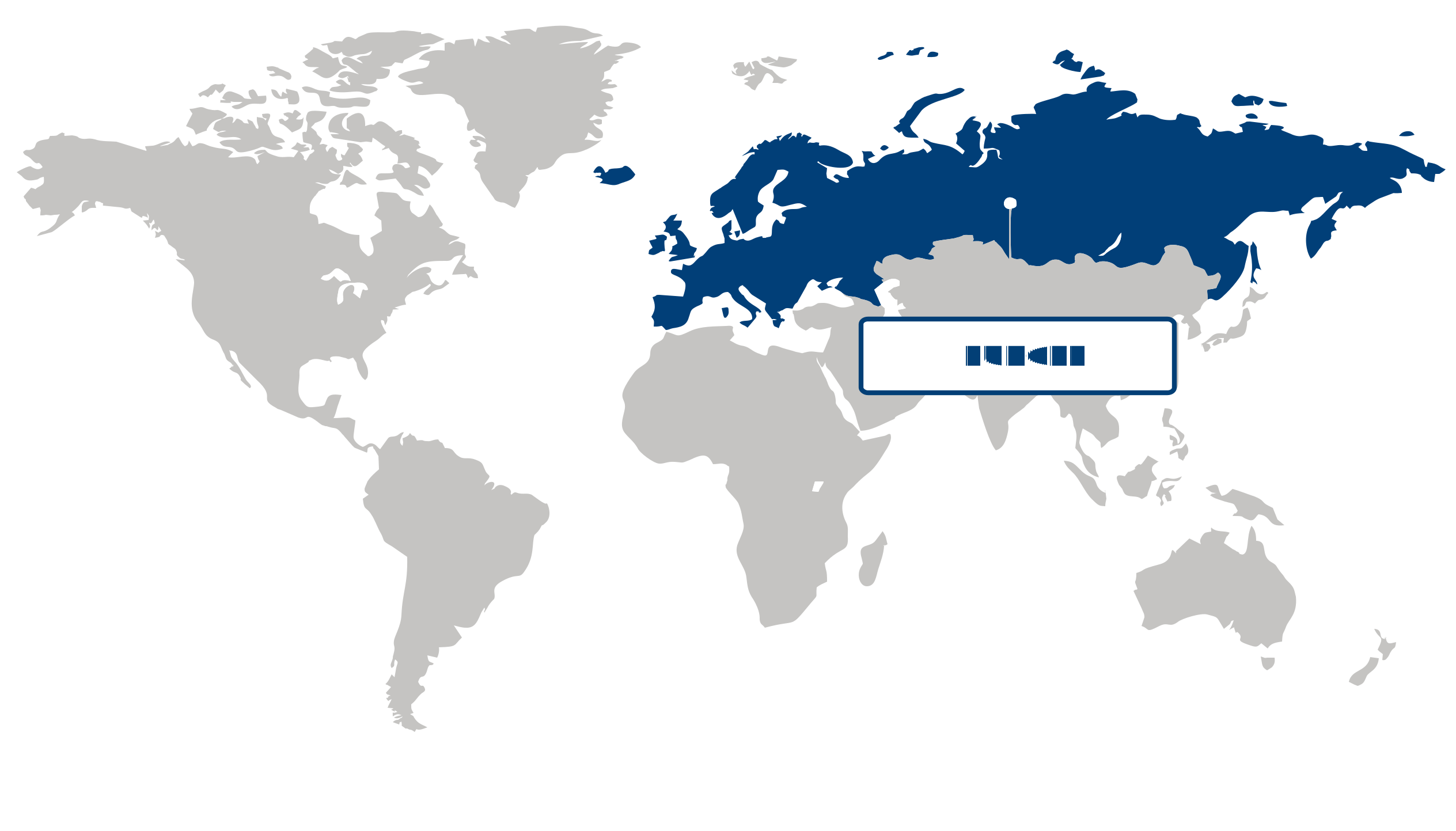
Europe (Largest Region)
Europe held the largest share of the heating radiator market at 36.57% in 2026, supported by established residential heating infrastructure, strong demand for energy-efficient systems, and sustained attention to building energy performance. The region’s mature construction sector and extensive presence of older buildings create continued opportunities for radiator replacement and heating-system modernization. Regulatory emphasis on reducing energy consumption and improving building efficiency is also encouraging consumers and property owners to adopt advanced heating solutions. In addition, growing interest in low-carbon heating technologies and integration with modern building-management systems is strengthening demand for radiators that provide greater controllability and efficient heat distribution.
Asia Pacific (Fastest-Growing Region)
Asia Pacific is emerging as the fastest-growing region, driven by urbanization, expanding residential construction, and rising investment in commercial and industrial infrastructure. Increasing household incomes and changing living standards are supporting greater adoption of reliable indoor heating systems, particularly in areas where colder seasonal conditions create a growing need for space-heating solutions. Infrastructure development and renovation of residential properties are further widening the addressable market. At the same time, increasing awareness of energy efficiency is encouraging demand for modern radiator technologies that can deliver effective heating while supporting lower energy consumption, creating favorable conditions for sustained regional expansion.
| Parameter | North America | Asia Pacific | Europe | Latin America | MEA |
|---|---|---|---|---|---|
| Innovation HubiScaleNascentDeveloping Advanced | |||||
| Cost-Sensitive RegioniScaleLowMedium High | |||||
| Regulatory EnvironmentiScaleRestrictiveNeutral Supportive | |||||
| Demand DriversiScaleWeakModerate Strong | |||||
| Development StageiScaleEmergingDeveloping Developed | |||||
| Adoption RateiScaleLowMedium High | |||||
| New Entrants / StartupsiScaleSparseModerate Dense | |||||
| Macro IndicatorsiScaleWeakStable Strong |
Key Country Insights
Germany 🇩🇪
Efficient Heating SystemsGermany continues investing in heating radiators compatible with energy-efficient residential and commercial heating solutions. German buyers increasingly favor products designed to work alongside low-temperature systems and sustainable building upgrades.
France 🇫🇷
Sustainable Renovation FocusFrance is encouraging heating radiator upgrades through building modernization and energy efficiency initiatives. Property owners across France increasingly select radiators that improve heating performance while complementing low-carbon renovation strategies.
Italy 🇮🇹
Design-Oriented HeatingItaly combines heating efficiency with architectural aesthetics, creating demand for radiators that complement interior design. Italian manufacturers continue developing products that balance thermal performance, premium finishes, and compatibility with modern heating installations.
Japan 🇯🇵
Compact Heating SolutionsJapan emphasizes space-efficient heating radiators suited to residential buildings and modern construction practices. Manufacturers in Japan focus on compact designs, reliable heat distribution, and compatibility with energy-conscious building systems.
South Korea 🇰🇷
Modern Building IntegrationSouth Korea is incorporating advanced heating radiators into new residential and commercial developments emphasizing energy performance. Domestic suppliers are enhancing product efficiency while supporting smart building and interior design requirements.
United States 🇺🇸
Energy Retrofit DemandThe U.S. heating radiator market is supported by building renovation projects and growing interest in energy-efficient heating systems. Manufacturers serving the U.S. are introducing radiator designs that improve thermal performance and integrate with modern heating infrastructure.
Heating Radiator Market Share (%), by Product, 2026
Go beyond the chart, access full insights & data tables
Request Free Sample ReportProduct Segment Analysis: Hydronic Heating Radiators (Largest Segment) vs Electric Heating Radiators (Fastest-Growing Segment)
Hydronic heating radiators represented the largest product segment in the heating radiator market, holding a 59.66% share in 2026. Their established use in centralized heating systems is supported by reliable heat distribution, compatibility with boilers and other hydronic heating infrastructure, and suitability for both commercial and industrial buildings. Hydronic systems remain attractive where consistent indoor heating and integration with existing water-based heating networks are priorities. Continued investment in building heating infrastructure and upgrades to energy-efficient heating systems further supports demand for hydronic radiators.
Electric heating radiators are expanding more rapidly as consumers and building operators seek flexible heating solutions that can be installed without extensive water-based distribution infrastructure. Their suitability for individual rooms and decentralized heating applications provides greater installation flexibility, particularly where extending centralized heating systems is impractical. The broader movement toward building electrification, combined with demand for convenient and controllable heating technologies, is creating favorable conditions for electric radiator adoption.
Application Segment Analysis: Industrial (Largest Segment) vs Residential (Fastest-Growing Segment)
The industrial segment accounted for the largest share of the heating radiator market at 36.15% in 2026, driven by the need to maintain suitable thermal conditions across production facilities, workshops, warehouses, and other industrial environments. Industrial buildings often require dependable heating solutions that can support worker comfort, equipment operation, and stable indoor conditions across large or demanding spaces. The durability and heat distribution capabilities of radiator systems make them relevant for facilities seeking reliable space heating while upgrading or maintaining their thermal infrastructure.
Residential applications are advancing at a faster pace as households increasingly prioritize energy efficiency, heating comfort, and greater control over indoor temperatures. Electric and modern hydronic radiator technologies offer flexible options for both new homes and renovation projects, while improved controls enable users to manage heating according to occupancy and individual room requirements. Rising attention to building energy performance and the modernization of residential heating systems is supporting broader adoption across the household segment.
| Segment | Sub-Segment | Largest Segment | Fastest Growing |
|---|---|---|---|
| Product | Hydronic Heating Radiators, Electric Heating Radiators | Hydronic Heating Radiators | Electric Heating Radiators |
| Application | Residential, Industrial, Commercial | Industrial | Residential |
Competitive Landscape and Market Positioning
Key companies in the heating radiator market:
1. Stelrad Group plc (U.K.)
2. Purmo Group Plc (Finland)
3. Vasco Group NV (Belgium)
4. IRSAP S.p.A. (Italy)
5. KORADO a.s. (Czech Republic)
6. Runtal North America Inc. (U.S.)
7. U.S. Boiler Company Inc. (U.S.)
8. Hunt Heating Pty Ltd. (Australia)
9. H2O Heating Pty Ltd. (Australia)
10. Zehnder Group AG (Switzerland)
The heating radiator market is evolving through improved thermal efficiency and smart heating integration. Modern designs are enhancing energy optimization in residential and commercial spaces. The heating radiator market continues to grow as energy-efficient heating solutions gain wider adoption.
| Company | Market Share | Company Revenue | Revenue CAGR (%) | Product Portfolio | Geographic Presence | Innovation / R&D Focus | Strategic Developments |
|---|---|---|---|---|---|---|---|
| Stelrad Group plc (U.K.) | |||||||
| Purmo Group Plc (Finland) | |||||||
| Vasco Group NV (Belgium) | |||||||
| IRSAP S.p.A. (Italy) | |||||||
| KORADO a.s. (Czech Republic) | |||||||
| Runtal North America Inc. (U.S.) | |||||||
| U.S. Boiler Company Inc. (U.S.) | |||||||
| Hunt Heating Pty Ltd. (Australia) | |||||||
| H2O Heating Pty Ltd. (Australia) | |||||||
| Zehnder Group AG (Switzerland). |
Industry Development / News
| Company Name | Date | Key Development |
|---|---|---|
| Leading heating equipment manufacturer | 2025 | The company introduced a new energy-efficient aluminum radiator designed for compatibility with low-temperature heat pump systems. This development strengthens alignment with evolving residential heating infrastructure, supporting improved thermal efficiency and positioning the manufacturer within the transition toward low-carbon heating technologies in residential and retrofit construction markets. |
| Radiator manufacturer | 2024 | The company launched a smart radiator control system enabling mobile and smart home-based heating regulation. This advancement integrates digital control functionality into traditional radiator systems, supporting improved energy management, user convenience, and alignment with broader smart home and connected building trends. |
| Global heating equipment provider | 2024 | The company expanded production capacity for steel panel radiators to meet increasing demand from residential construction projects. This capacity expansion enhances supply availability in a growing housing-driven demand environment and reinforces manufacturing scalability within core radiator product segments. |
| Major HVAC equipment manufacturer | 2023 | The company developed a designer radiator series targeting luxury residential and commercial interior applications. This product expansion strengthens its positioning in premium architectural heating solutions, supporting differentiation through design-led offerings in high-value building segments. |
| Radiator technology company | 2023 | The company introduced a compact electric radiator system designed for modern apartments and small commercial spaces. This product innovation addresses space-constrained urban applications and supports diversification into electric heating solutions aligned with evolving residential infrastructure needs. |
Customize Your Report
Explore examples of how this report can be tailored to different research needs, including custom segments, additional topics or chapters, and related reports. Click a section of the wheel or its numbered marker to explore the available options.
Heating Radiator Market — Custom Segments
| Segment | Sub-Segment |
|---|---|
| Energy Source | Natural Gas, Electricity, Renewable Energy, District Heating, Other Energy Sources |
| Building Type | Single-Family Residential, Multi-Family Residential, Office & Commercial Buildings, Hospitality & Institutional Buildings, Industrial Facilities |
| Distribution Channel | Direct Sales, HVAC Distributors, Plumbing & Heating Distributors, Retail & Home Improvement Stores, Online Channels |
Heating Radiator Market — Custom TOC
| Custom Chapter | Chapter Details |
|---|---|
| Building Decarbonization Impact Assessment |
|
| Smart Heating Adoption Roadmap |
|
| Residential Heating Upgrade Opportunity Analysis |
|
Need a different cut of the data?
Request Custom ResearchFrequently Asked Questions
How big is the heating radiator market?
What is the expected industry size of heating radiator by 2036?
How are energy efficiency priorities influencing product adoption in the heating radiator market?
What role do smart heating technologies play in market growth?
Why do hydronic heating radiators dominate the market?
Why is residential demand growing in the heating radiator market?
Why is Europe the leading market for heating radiators?
What is driving heating radiator market growth in Asia Pacific?
Who are the major participants shaping the heating radiator landscape?
Our Clients
"Your insights on workforce structures were spot-on. The analysis on mid-to-senior level roles validated some of our hiring decisions and highlighted gaps."
Ateliers De France
"The report gave us insights on competitors in the market. It helped our team refine our bidding strategy for upcoming contracts."
Clark Construction
"The reports provided a deep dive into market trends, and competitive landscape. The strategic insights and recommendations have been very helpful."
Rudolph and Sletten
Our Research Team & Methodology
Every Fundamental Business Insights report is built by a dedicated vertical research team, validated through a structured primary-and-secondary methodology, and reviewed for accuracy before it reaches you.
Delivery
Published
Available
Support
- Market Size & Forecast
- Market Segmentation
- Regional Analysis
- Growth Drivers & Challenges
- Market Dynamics
- Competitive Landscape
- Company Profiles
- Competitive Benchmarking
- Mergers & Acquisitions
- Market Share Analysis or Key Company Strategies
- Value Chain Analysis
- Porter's Five Forces
- PESTLE Analysis
- Pricing Trends
- Supply-Demand Analysis
- Technology Landscape
- Regulatory Landscape
- Investment & Funding Landscape
- Emerging Opportunities
- Future Market Outlook