Residential Underfloor Heating Actuator Market Size & Growth Forecast 2027–2036, By Segments (Product), Regional Demand Trends (North America, Asia Pacific, Europe), Key Country Insights (U.S., Japan, South Korea, Germany, France, Italy), and Competitive Landscape
Market Size and Growth Outlook
Residential Underfloor Heating Actuator Market size was valued at USD 204.8 Million in 2026 and is anticipated to grow at 5.29% CAGR from 2027 to 2036, attaining USD 342.93 Million by 2036. The industry revenue for 2027 is assessed at USD 213.83 Million.
Get more details on this report
Request Free Sample ReportResidential Underfloor Heating Actuator Market Intelligence Snapshot
Regional Market Dynamics
- Europe leads through mature underfloor heating adoption, residential renovation activity, energy-efficiency priorities, and increasing integration of precise heating controls.
- Asia Pacific is growing fastest as residential construction, urbanization, smart-home adoption, and demand for efficient indoor climate-control technologies expand.
Segment Momentum
- The thermal segment accounted for 62.01% of the market in 2026 due to its reliable operation, cost-effectiveness, low maintenance requirements, and compatibility with a wide range of residential heating systems.
- The motoric segment is expected to grow the fastest as smart home adoption and advanced energy management systems increase demand for precise heating control, improved responsiveness, and greater energy efficiency.
Market Expansion Drivers
- Energy efficiency regulations driving adoption of smart underfloor heating control systems
- Rising smart home penetration accelerating automated residential climate control systems
- Government incentives promoting low-carbon residential heating modernization across urban housing
Leading Market Participants
- Top companies in the residential underfloor heating actuator market include Danfoss A/S (Denmark), Honeywell International Inc. (United States), Siemens AG (Germany), Uponor Corporation (Finland), Oventrop GmbH & Co. KG (Germany), Sauter AG (Switzerland), Theben AG (Germany), Heatmiser UK Ltd (United Kingdom), Warmup Plc (United Kingdom)
Global Market Forecast Snapshot
Market Outlook
- 2026 Market Size: USD 204.8 Million
- 2027 Estimated Market Size: USD 213.83 Million
- Projected Market Size: USD 342.93 Million by 2036
- Growth Forecast: 5.29% CAGR (2027-2036)
Regional and Segment Outlook
- Leading Regional Market: Europe
- High-Growth Regional Hub: Asia Pacific
- Core Revenue Segment: Thermal (Product)
- Emerging Opportunity Segment: Motoric (Product)
Market Growth Drivers and Industry Trends
Energy efficiency regulations driving adoption of smart underfloor heating control systems
Increasing emphasis on reducing residential energy consumption is encouraging homeowners and builders to adopt advanced heating control solutions that improve system efficiency. This shift will drive the residential underfloor heating actuator market growth as smart actuators enable precise temperature regulation, zone-based heating management, and optimized energy usage. Integration with modern heating systems allows users to maintain indoor comfort while reducing unnecessary energy expenditure, supporting broader adoption of intelligent climate control technologies in residential spaces.
Rising smart home penetration accelerating automated residential climate control systems
The expansion of connected home ecosystems is transforming traditional heating solutions into digitally managed systems with automated control capabilities. The residential underfloor heating actuator market is gaining momentum as smart home adoption increases demand for actuators that integrate with sensors, thermostats, and home automation platforms. These connected solutions provide homeowners with improved convenience through remote access, scheduling features, and adaptive temperature management that aligns heating performance with changing household needs.
Government incentives promoting low-carbon residential heating modernization across urban housing
Public initiatives focused on reducing building emissions are encouraging the replacement of conventional heating systems with more sustainable alternatives. The residential underfloor heating actuator market will benefit from government-supported modernization programs as urban housing projects increasingly incorporate efficient heating technologies designed to lower carbon footprints. Incentives for energy-efficient renovations and sustainable construction practices are motivating property developers and homeowners to upgrade heating infrastructure with advanced control components.
| Growth Driver | Impact on CAGR | Regulatory Influence | Geographic Relevance | Adoption Rate | Impact Timeline |
|---|---|---|---|---|---|
| Energy efficiency regulations driving adoption of smart underfloor heating control systems | 2% | High | Europe, North America | High | Near Term |
| Rising smart home penetration accelerating automated residential climate control systems | 1.7% | Moderate | North America, Europe | High | Mid Term |
| Government incentives promoting low-carbon residential heating modernization across urban housing | 1.5% | High | Europe, Asia Pacific | High | Mid Term |
Explore Growth Opportunities
Request Free Sample ReportRegional Demand Dynamics
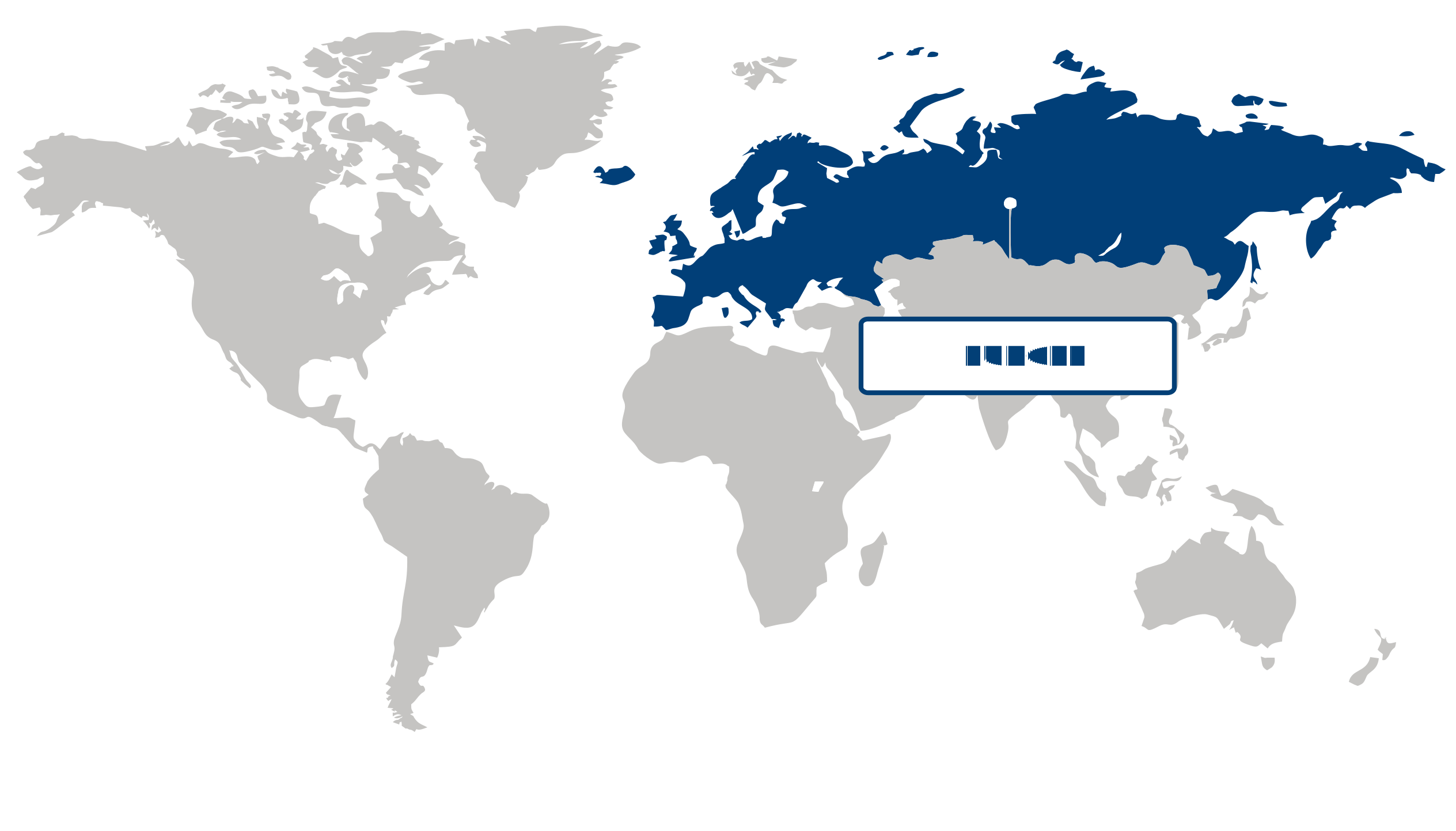
Europe (Largest Region)
The residential underfloor heating actuator market was led by Europe in 2026, reflecting the region’s mature adoption of underfloor heating systems, strong residential renovation activity, and emphasis on energy-efficient building technologies. Increasing efforts to improve household energy performance are encouraging the integration of precise heating controls, including actuators that regulate individual heating zones and enhance system efficiency. The expansion of smart-home technologies and greater consumer awareness of controllable indoor heating are also supporting demand, while building-efficiency requirements continue to encourage modernization of residential heating infrastructure.
Asia Pacific (Fastest-Growing Region)
Asia Pacific is anticipated to register the fastest regional growth, supported by expanding residential construction, improving living standards, and increasing interest in modern indoor climate-control technologies. Rising urbanization is creating demand for efficient and space-saving heating solutions in newly developed residential properties, particularly where colder climates increase the need for dependable heating systems. Growing adoption of smart-home technologies is further creating opportunities for electronically controlled underfloor heating systems, while increasing awareness of household energy efficiency is encouraging consumers and developers to consider more sophisticated heating-control components.
| Parameter | North America | Asia Pacific | Europe | Latin America | MEA |
|---|---|---|---|---|---|
| Innovation Hub i Scale Nascent Developing Advanced | |||||
| Cost-Sensitive Region i Scale Low Medium High | |||||
| Regulatory Environment i Scale Restrictive Neutral Supportive | |||||
| Demand Drivers i Scale Weak Moderate Strong | |||||
| Development Stage i Scale Emerging Developing Developed | |||||
| Adoption Rate i Scale Low Medium High | |||||
| New Entrants / Startups i Scale Sparse Moderate Dense | |||||
| Macro Indicators i Scale Weak Stable Strong |
Key Country Insights
United States 🇺🇸
Smart Home CompatibilityThe U.S. residential underfloor heating actuator market is benefiting from increased adoption of smart home heating controls and energy-efficient residential upgrades. Homeowners are favoring actuators that integrate with connected thermostats and zoning systems for improved comfort and energy management.
Germany 🇩🇪
Precision Heating ControlGermany is prioritizing residential underfloor heating actuators that provide accurate temperature regulation and compatibility with advanced hydronic heating systems. Demand is supported by energy-conscious homeowners seeking efficient room-by-room heating control during renovation and new residential construction.
Japan 🇯🇵
Space-Efficient ComfortJapan is adopting compact underfloor heating actuators that complement residential designs where efficient space utilization is important. Manufacturers are focusing on quiet operation, dependable performance, and seamless integration with automated home heating systems.
South Korea 🇰🇷
Connected Residential HeatingSouth Korea is expanding the use of underfloor heating actuators as smart residential technologies become more common in new housing developments. Suppliers are enhancing actuator responsiveness and connectivity to support precise heating control and greater household energy efficiency.
France 🇫🇷
Energy-Conscious RenovationFrance is integrating residential underfloor heating actuators into home renovation projects focused on improving heating efficiency and occupant comfort. Consumers are seeking reliable actuator technologies that enable zoning capabilities and efficient operation with modern heating systems.
Italy 🇮🇹
Hydronic System OptimizationItaly is strengthening adoption of residential underfloor heating actuators through continued preference for hydronic heating solutions in homes. Manufacturers are offering durable actuators that improve temperature consistency while supporting efficient operation across a variety of residential layouts.
Segment Leadership and Growth Trends
Residential Underfloor Heating Actuator Market Share (%), by Product, 2026
Go beyond the chart, access full insights & data tables
Request Free Sample ReportProduct Segment Analysis: Thermal (Largest Segment) vs Motoric (Fastest-Growing Segment)
Holding the largest share of the residential underfloor heating actuator market, the thermal product segment accounted for 62.01% of the market in 2026. Its strong market position is supported by its dependable operation, cost-effectiveness, and compatibility with a wide range of residential underfloor heating systems. Homeowners continue to prefer thermal actuators for their reliable temperature regulation, minimal maintenance requirements, and straightforward integration with conventional heating controls, reinforcing the segment's market leadership.
The motoric product segment is expected to experience the fastest growth as demand increases for more precise and intelligent heating control solutions. Growing adoption of smart home technologies, connected thermostats, and advanced energy management systems is encouraging greater deployment of motoric actuators. Their ability to provide accurate flow regulation, improved responsiveness, and enhanced energy efficiency aligns with the evolving requirements of modern residential heating systems.
| Segment | Sub-Segment | Largest Segment | Fastest Growing |
|---|---|---|---|
| Product | Thermal, Motoric | Thermal | Motoric |
Unlock insights tailored to your business with our bespoke market research solutions.
Click to get your customized report now.
Competitive Landscape and Market Positioning
Prominent players in the residential underfloor heating actuator market:
- Danfoss A/S (Denmark)
- Honeywell International, Inc. (United States)
- Siemens AG (Germany)
- Uponor Corporation (Finland)
- Oventrop GmbH & Co. KG (Germany)
- Sauter AG (Switzerland)
- Theben AG (Germany)
- Heatmiser UK Ltd (United Kingdom)
- Warmup Plc (United Kingdom)
Competitive dynamics in the residential underfloor heating actuator market are increasingly influenced by integration with intelligent building systems rather than by mechanical performance alone. Suppliers are expanding their focus toward actuators that communicate seamlessly with smart thermostats, zoning controls, and home automation platforms, allowing installers to simplify system commissioning and homeowners to improve energy management. As residential heating projects place greater emphasis on long-term efficiency and ease of maintenance, manufacturers capable of delivering dependable interoperability, compact designs, and consistent installation quality are strengthening their position across both new construction and renovation applications.
| Company | Market Share | Company Revenue | Revenue CAGR (%) | Product Portfolio | Geographic Presence | Innovation / R&D Focus | Strategic Developments |
|---|---|---|---|---|---|---|---|
| Danfoss A/S (Denmark) | |||||||
| Honeywell International Inc. (United States) | |||||||
| Siemens AG (Germany) | |||||||
| Uponor Corporation (Finland) | |||||||
| Oventrop GmbH & Co. KG (Germany) | |||||||
| Sauter AG (Switzerland) | |||||||
| Theben AG (Germany) | |||||||
| Heatmiser UK Ltd (United Kingdom) | |||||||
| Warmup Plc (United Kingdom) |
Industry Development/News
| Company Name | Date | Key Development |
|---|---|---|
| Ambiente | Jun-23 | Ambiente launched AmbiEgo, an intelligent self-balancing actuator designed for rapid installation in underfloor heating systems. Supporting both heating and cooling circuits, the technology eliminates the need for exhaustive initial system design, incorporating artificial intelligence to streamline operational deployment, reduce installation time, and enhance overall efficiency. |
| Sauter AG | Aug-21 | Sauter AG introduced the SAUTER AXT4 valve actuator, integrating established thermal technology to deliver energy-efficient control precision. The compact design features straightforward installation and manual re-open capabilities suitable for underfloor heating, radiators, and chilled ceilings, strengthening the company's product portfolio and competitive positioning in thermal control applications. |
Customize Your Report
Explore examples of how this report can be tailored to different research needs, including custom segments, additional topics or chapters, and related reports. Click a section of the wheel or its numbered marker to explore the available options.
Residential Underfloor Heating Actuator Market — Custom Segments
| Segment | Sub-Segment |
|---|---|
| Heating System Integration | Hydronic Underfloor Heating, Radiant Wall & Ceiling Heating, Multi-Zone Radiant Heating |
| Dwelling Type | Single-Family Homes, Multi-Family Residential Buildings, Apartments & Condominiums |
| Installation Lifecycle | New Construction, Retrofit & Renovation |
Residential Underfloor Heating Actuator Market — Custom TOC
| Custom Chapter | Chapter Details |
|---|---|
| Smart Home Heating Integration Outlook |
|
| Actuator Replacement & Upgrade Opportunities |
|
| Energy-Efficiency Adoption Pathways |
|
Need a different cut of the data?
Request Custom ResearchHow large is the residential underfloor heating actuator market?
How is the residential underfloor heating actuator industry expected to grow over the next 10 years?
How is smart home adoption driving the residential underfloor heating actuator market?
Why are energy efficiency regulations boosting adoption of underfloor heating actuators?
Why does the thermal product segment dominate the residential underfloor heating actuator market?
Which product segment is expected to grow the fastest in the residential underfloor heating actuator market?
Why does Europe lead the residential underfloor heating actuator market?
How is Asia Pacific driving growth in residential underfloor heating actuators?
Who holds a significant market share in the residential underfloor heating actuator landscape?
Our Clients
"Your insights on workforce structures were spot-on. The analysis on mid-to-senior level roles validated some of our hiring decisions and highlighted gaps."
Ateliers De France
"The report gave us insights on competitors in the market. It helped our team refine our bidding strategy for upcoming contracts."
Clark Construction
"The reports provided a deep dive into market trends, and competitive landscape. The strategic insights and recommendations have been very helpful."
Rudolph and Sletten
Our Research Team & Methodology
Every Fundamental Business Insights report is built by a dedicated vertical research team, validated through a structured primary-and-secondary methodology, and reviewed for accuracy before it reaches you.
Research Team Overview
Prepared by the Construction & Manufacturing Research Team
Delivery
Published
Demand
Available
Support
Trust & Compliance
Research Intelligence
| Source | Reference |
|---|---|
| International Organization for Standardization (ISO) | www.iso.org |
| ASTM International | www.astm.org |
| National Institute of Standards and Technology (NIST) | www.nist.gov |
| International Code Council (ICC) | www.iccsafe.org |
| American Concrete Institute (ACI) | www.concrete.org |
| American Institute of Steel Construction (AISC) | www.aisc.org |
| Construction Industry Institute (CII) | www.construction-institute.org |
| Associated General Contractors of America (AGC) | www.agc.org |
| Association of Equipment Manufacturers (AEM) | www.aem.org |
| Building Owners and Managers Association (BOMA) | www.boma.org |
| American Society of Civil Engineers (ASCE) | www.asce.org |
| National Ready Mixed Concrete Association (NRMCA) | www.nrmca.org |
| International Facility Management Association (IFMA) | www.ifma.org |
| World Green Building Council (WorldGBC) | worldgbc.org |
| International Federation of Consulting Engineers (FIDIC) | fidic.org |
| International Labour Organization (ILO) | www.ilo.org |
| American Society of Mechanical Engineers (ASME) | www.asme.org |
| Society of Manufacturing Engineers (SME) | www.sme.org |
| National Association of Home Builders (NAHB) | www.nahb.org |
| European Construction Industry Federation (FIEC) | www.fiec.eu |
Research Workflow & Quality Assurance
Data Collection
Verified information gathered through primary and secondary research.
Data Triangulation
Cross-validation using multiple independent data sources.
Forecast Modelling
Market estimates developed using historical trends and analytical models.
Analyst Validation
Findings reviewed by domain experts for accuracy and consistency.
Editorial & Quality Review
Final editorial, quality, and compliance checks before publication.
Final Publication
Released after successful completion of the internal review process.
Report Coverage
📊 Market Assessment
- Market Size & Forecast
- Market Segmentation
- Regional Analysis
- Growth Drivers & Challenges
- Market Dynamics
🏢 Competitive Intelligence
- Competitive Landscape
- Company Profiles
- Competitive Benchmarking
- Mergers & Acquisitions
- Market Share Analysis or Key Company Strategies
🔍 Strategic Analysis
- Value Chain Analysis
- Porter's Five Forces
- PESTLE Analysis
- Pricing Trends
- Supply-Demand Analysis
🚀 Future Outlook
- Technology Landscape
- Regulatory Landscape
- Investment & Funding Landscape
- Emerging Opportunities
- Future Market Outlook
Have a question about this report or need a custom scope?
Request Customization